The Role of Religion in the Development and Abandonment of African Culture

Africa is allegedly home to the most religious people in the world, with deeply ingrained beliefs, rituals, and customs. Religion is believed to be one of the earliest forms of human culture, predating even agriculture and cities. In his book “Sapiens: A Brief History of Humankind,” Yuval Noah Harari argues that religion played a significant role in the development of human civilization. Religion provided a way for humans to create and maintain shared beliefs and values, fostering cooperation and social cohesion. Additionally, religion gave a sense of meaning and purpose to people’s lives, offering explanations for the natural world and human existence, and providing a sense of order and stability. Furthermore, religion created and reinforced social hierarchies and power structures. Thus, religion played a crucial role in providing a framework for shared beliefs, social cohesion, and meaning-making in human societies throughout history.

Portrait of an attractive and smiling 50 year old African woman dressed in a traditional African dress

However, what role did religion play in the abandonment of African culture and how did it aid in promoting racism and the inferiority of the black race? During the pre-colonial era, when missionaries arrived in Africa, their mission was to Christianize the black people with the presumption that their ways were primitive and their beliefs heathen. The missionaries believed in the biblical account of Ham, one of the three sons of Noah, who was allegedly black and cursed. This belief, coupled with the popular 19th-century pseudoscience that used dubious scientific methods to prove the superiority of the white race over the black race, led to the justification of slavery, colonization, and Christianization of Africa.

Christianity in itself is neither bad nor racist, nor is religion in general. But it was used as a tool to systematically lead Africans to abandon their cultures and traditions, most of which were good. The indoctrination of the continent has led to the vast majority abandoning the values of hard work and sacrifice for beliefs in prayer and miracles. As a result, there are numerous churches all over Africa where believers flock to and give their last dime to get a miracle.

Religion, in my opinion, did not set Africans free, but rather bound them to belief systems that left them vulnerable to exploitation. Africans quickly forgot that the promised paradise was what they were already living in. Instead of moving at the same pace as the rest of the world in terms of development, they were reduced to ethnic and religious wars as the colonizers looted the natural wealth of the continent.

Should Africa abandon religion? Absolutely not. And replace it with what? Remember that religion was there long before racism and colonialism existed. Belief is the basis of the morals of society. Once beliefs are eradicated, the society starts to decay. The only thinkable solution, in my estimation, would be for everyone to start accepting and appreciating African cultures. People, including Africans, should educate themselves on the deep-rooted beliefs that Blacks are inferior to other races.

Where would you start? Do you really know how ancient African societies lived? Are there practices and customs that would have been helpful for modern society? How can we help Africans use their rich natural resources to develop themselves? Speaking of natural resources, could they be the cause of Africa being the poorest and least developed continent in the world? We will cover the topic of natural resources in the next blog.


“How to Win at Life: Unlocking the Hidden Lessons of Chess from Strategy and Determination to Self-Discipline and Focus”

Chess is a game that has been enjoyed for centuries by people of all ages and walks of life. It can be seen as a metaphor for life, with the pieces and movements on the board representing different aspects of our own lives. In this blog, we will explore the life lessons and personal development opportunities that can be gained from playing chess.

One important lesson from chess is the value of strategy. To win a game, players must think ahead and plan their moves carefully. This requires strategic thinking and problem-solving skills, which are also essential in life. Whether it’s achieving a personal goal or succeeding in a career, having a clear plan and the ability to think ahead can help you achieve your objectives.

Another valuable lesson from chess is the importance of persistence and determination. Even the best players lose games from time to time, and it’s important to remember that setbacks and failures are a natural part of life. Successful people are those who can keep going even when things don’t go as planned. By learning to persevere and stay determined, you can achieve your goals and overcome obstacles.

Specific strategies and techniques can also be learned from chess. For example, controlling the center of the board is key to dominating the game and putting pressure on your opponent’s pieces. In life, it’s also important to focus on what’s most important and have control over it to set yourself up for success.

In addition, each piece in chess has its own unique characteristics and abilities, which can be seen as representing different personality traits in the context of human society. The hierarchical nature of the game, with the king at the top and the pawns at the bottom, can also be seen as a metaphor for how society is organized.

Original Image created by nightcafe creator.

The king, who is the most powerful piece on the board, represents leadership and authority and is responsible for ensuring the safety of the other pieces. In society, leaders and those in positions of power often possess similar characteristics – they are responsible for guiding and protecting their communities, and must make difficult decisions that can affect the lives of many people.

The queen, which is the second most powerful piece in chess, represents intelligence and the ability to think strategically. The queen can move in any direction and can be a formidable opponent if used effectively. In society, those who are intelligent and able to think creatively and solve problems are often held in high regard and can achieve great things.

The bishops and knights, which are slightly less powerful than the queen, represent adaptability and the ability to navigate complex situations. Bishops can move diagonally across the board, while knights can jump over other pieces, making them highly versatile. In society, those who can adapt and navigate difficult situations are often respected for their problem-solving skills.

Finally, the rooks and pawns, which are the least powerful pieces in chess, represent hard work and the ability to grind out victories. Rooks can move horizontally and vertically across the board, while pawns can only move forward and can only capture pieces that are directly in front of them. In society, those who are willing to put in hard work and persevere through challenges are often able to achieve their goals and succeed.

Finally, chess requires self-discipline and focus. To succeed, players must be able to concentrate and stay focused on the task at hand, even when things get tough. This is a valuable skill in any area of life and can help you reach your full potential.

In conclusion, chess offers many valuable lessons for life and personal development. From the importance of strategy and determination to the value of self-discipline and focus, and the ability to adapt and navigate complex situations, there are countless ways in which the game can help us grow and improve as individuals. Whether you’re a seasoned player or just starting out, there’s always something new to learn and discover.

“Say Goodbye to the Art of Creative Writing: The Imminent Death of Blogging with the Launch of ChatGPT 4”

As the world eagerly awaits the launch of ChatGPT 4, a new and advanced language model developed by OpenAI, many in the blogging community are left wondering about the fate of creative writing. With the ability to generate human-like text with ease, it seems that the art of crafting thoughtful and engaging blog posts may be facing an imminent death.

The truth is, ChatGPT 4 is a game changer. With its advanced capabilities and sophisticated algorithms, it can generate text that is indistinguishable from that written by human writers. This means that bloggers, who have built their careers on the art of creative writing, will soon find themselves competing against a machine that can produce content faster, more efficiently, and with a level of accuracy that is unparalleled.

But it’s not just bloggers who will be impacted. Content creators of all types, from journalists to copywriters, will also find themselves facing increased competition from ChatGPT 4. The future of creative writing as we know it is uncertain, and the ramifications of this technology will be far-reaching.

For bloggers, the question becomes not just how to compete with a machine, but whether it’s even possible. With ChatGPT 4 able to generate text that is indistinguishable from that written by humans, it’s hard to see how bloggers can continue to create unique and engaging content that will attract readers.

Many bloggers have built their careers on the art of creative writing, but with the advent of ChatGPT 4, it seems that this art may soon become obsolete. While the technology has the potential to revolutionize the way we create and consume content, it also has the potential to put many bloggers out of work.

It’s not all doom and gloom, however. There are still ways for bloggers to survive in this new world. One way is to focus on niche topics and areas of expertise that ChatGPT 4 may not be able to replicate. For example, a blogger who specializes in a specific niche, such as travel or fashion, may be able to continue creating unique and engaging content that their readers will continue to enjoy.

Another way for bloggers to survive is to adapt their writing style and focus on creating more personal and emotive content. After all, while ChatGPT 4 may be able to generate text that is indistinguishable from that written by humans, it can’t replicate the human experience. Bloggers who focus on creating content that is personal and emotive, such as diary entries or personal essays, may be able to carve out a niche for themselves in the new world of content creation.

In conclusion, the launch of ChatGPT 4 is undoubtedly a game changer for the world of creative writing. It has the potential to revolutionize the way we create and consume content, but it also has the potential to put many bloggers and content creators out of work. But for those who are willing to adapt, there are still opportunities for survival in this new world. Niche topics and areas of expertise, as well as a focus on personal and emotive content, maybe the key to success in the new era of content creation.

Text and Picture were generated by ChatGP3 and Nightcafe AI respectively.

Your Mind is your keeper, not your friend Part 3

Making your Mind your friend through Gratitude.

Gratitude is a very portent practice in bringing joy and well-being into life. The personal development sector is awash with numerous articles on why and how to use Gratitude as a practice to bring happiness, positivity and success into your life.

There are many ways of practising Gratitude. The most common is thinking of stuff you are grateful for, writing them down every day, and reflecting on them. I have tried that for some time, and it has had little effect on me. Waking up every day and thinking of what I am grateful for has given me an excellent start to the day. But that lasted only a couple of hours. After a week of doing that, I found myself scratching my head to find new stuff that I can be grateful for so that I am not constantly repeating myself. Sooner or later, I quit the practice altogether because I was no longer getting the desired effect.

Then I heard a podcast by Andrew Hubermann https://youtu.be/KVjfFN89qvQ. He explained where most people, including myself, get it wrong with the Gratitude practice. In this blog entry, I will not water down Dr Hubermann’s work by attempting to summarise it. So I urge you, dear reader, after reading my blog, go listen to it. It will definitely positively change the way you practice Gratitude.

My previous gratitude practice didn’t work because, at some point, the emotional connection was cut off between what I am grateful for and how I am feeling at that moment. Dr Hubermann explains: “you can’t fool your mind”, if the moment is crapy, it is crapy.

Now, the better gratitude practice entails remembering a moment where you genuinely received Gratitude from someone after you are done doing them a good did. Closing your eyes and visualising this moment has a tremendous impact on producing happy hormones. Studies have shown that the brain activity in Raphe Nucleus, which makes the happy hormone serotonin, is triggered by this practice of Gratitude.

It goes dipper when you hear of a story of how someone helped out another and was genuinely appreciated; as a result, the same part of the brain is also activated. That is why bible stories of Jesus are so powerful. Because they show how a compassionate man helped out needy fellows.

I decided to try out the practice as suggested by Dr Hubermann. So, my day job is driving the Tram. As I cruised one day, I tried to remember how I helped someone and they were genuinely grateful. I remembered how I approached a station some time ago and saw a phone lying on the ground. I stopped the Tram, came out and picked the phone from the ground. Then, after a while, the phone rang, and I answered to a distressed woman’s call who was thanking me so much for finding her daughter’s phone. I handed it back to her at my break and kindly declined a 10 euro reward from her. She was so grateful and wished me God’s blessings.

I smiled to myself, enjoying the sudden surge of serotonin in my system. But what happened next, I was not prepared for. At that very station, someone interrupted my bliss trip with a knock in my cabinet. He said he found a phone lying on the chair; someone must have dropped it and asked if I would be so kind as to give the owner if they called. How weird was that? I gladly accepted and thanked the man for his honesty and wished him a pleasant day.

The owner of the phone called and said he could not pick up the phone as he is a nurse at a hospital. I offered to bring it to him during my long break. He was delighted and tried to give me a 20 euro reward, which I again declined. I went back to work feeling so happy.

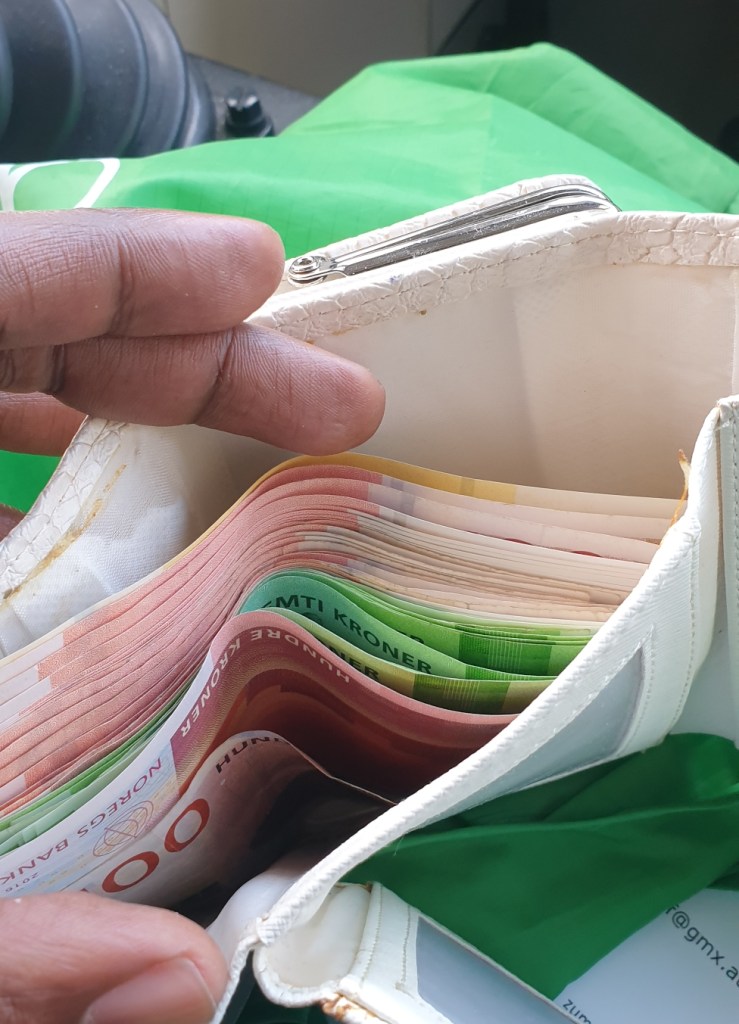
If you think that is the end of it all, you are not yet ready for this. Later that day, as I was doing the final round with the Tram, I went around checking for any lost and found items. I indeed found a green shopping bag. I took it with me to my driver’s cabin. I inspected to see if there were any valuables or contacts for the owner. I saw a purse and printouts with a name and address. In the purse were bills of an estimated 10,000 euros. As I debated in my mind whether to take the shopping bag to the police or deliver it personally to the owner, again, someone knocked at my driver’s cabin. It was a distressed old man. He asked if I had found a green shopping bag. I asked him for a name to confirm that it belonged to him. He gave his daughter’s correct names on the documents and explained that he was supposed to take the items to her, and he had feared he had completely lost them.

Having those experiences on the same days is entirely mind-blowing. Whenever I think of those experiences, I feel so happy about my honesty and how I saved that old man from the stress of explaining how he lost his daughter’s belongings. How did you feel when you read the joy the nurse had upon receiving his phone and the relief the old man had when he got his green bag back? A narrative is a powerful tool in triggering the right parts of our brain in response to a gratitude practice.

Next time tell a story about something good you did to someone and experience the surge of happiness as you recall the incident.

Your mind is your Keeper, not your friend. Part 2

Your Mind

There are times when we have thoughts that we have not voluntarily actively participated in. There are thoughts that randomly pop into your mind sometimes living you aghast and questioning your own sanity.

There are two parts of our brain. The limbic small primate older part is responsible for the cocktail of hormones that causes us to have a range of moods and emotions. Then there is the cortex the large evolutionary part where thoughts originate from.

One scientist described the cortex as a supercomputer whose sole purpose is doing what a monkey brain wants. In essence, the limbic brain is the boss and how you feel dictates the thoughts you will have. Makes sense? Let’s think of an example.

You have decided to go for a run after a short distance you feel tired. What goes on in your mind? You are flooded with suggestions on how the situation should be handled. Stop and walk back home, grab a taxi, sit down for a while then decide whether you want to continue or not, slow down run at a walking pace for just 100 meters then go home, you will do it next time. The cortex was basically trying to make you feel better by suggesting that you quit on your plan to do your 5k run.

Does this not happen all the time you are on to something challenging? My big one is talking to strangers. I generally love people but am a little shy. I would rather write a text or an email than make a phone call or meet someone in person. Whenever I need to call someone or just ask for help from a total stranger a crisis meeting is quickly convened in my head and very concrete arguments are presented on why I should not approach this stranger. Every time I went against those limiting thoughts it proved that my mind was just trying to protect me by keeping in my comfort zone. The cortex was just doing its job of making sure the stress hormones the limbic was releasing are contained.

 The cortex is sceptical and analytical and the limbic languishes in emotions. That’s why when one is under the influence of drugs or alcohol their base emotions are more visible. Because psychotics shut down or slow down the cortex. One expert recommended a shot of whiskey for participants before any tough negotiations started. He argues that this will ease the tension in the room and open up channels of communication.

It also explains why when one is high, they don’t think about their bills, their annoying bosses or their hateful neighbour. The part of the brain which does the worry was sent on a short leave. I am not recommending the use of drugs and alcohol to feel good. They might make you feel good but it is very short-lived and then the watchdog will be back and hammer you with regrets.

How do you use the two parts of your brain to ensure that you have an optimal life? The cortex will definitely prevent you from jumping over a cliff. So a lot of times it is good to take the crisis meetings seriously especially when indulging yourself. The limbic will infuse in your veins the feel-good hormones and you will radiate joy and positivity.

You need to decide when to override your cortex thoughts and when the lust for happy hormones will get you in trouble and therefore delayed gratification is probably a better idea. Finally whenever you find yourself in a situation where you don’t want to be or you fail or are disappointed by your own actions. Don’t allow your cortex to beat you up with guilt and understand that you are not your thoughts and your mind is not your friend it is your keeper.