The Role of Religion in the Development and Abandonment of African Culture

Africa is allegedly home to the most religious people in the world, with deeply ingrained beliefs, rituals, and customs. Religion is believed to be one of the earliest forms of human culture, predating even agriculture and cities. In his book “Sapiens: A Brief History of Humankind,” Yuval Noah Harari argues that religion played a significant role in the development of human civilization. Religion provided a way for humans to create and maintain shared beliefs and values, fostering cooperation and social cohesion. Additionally, religion gave a sense of meaning and purpose to people’s lives, offering explanations for the natural world and human existence, and providing a sense of order and stability. Furthermore, religion created and reinforced social hierarchies and power structures. Thus, religion played a crucial role in providing a framework for shared beliefs, social cohesion, and meaning-making in human societies throughout history.
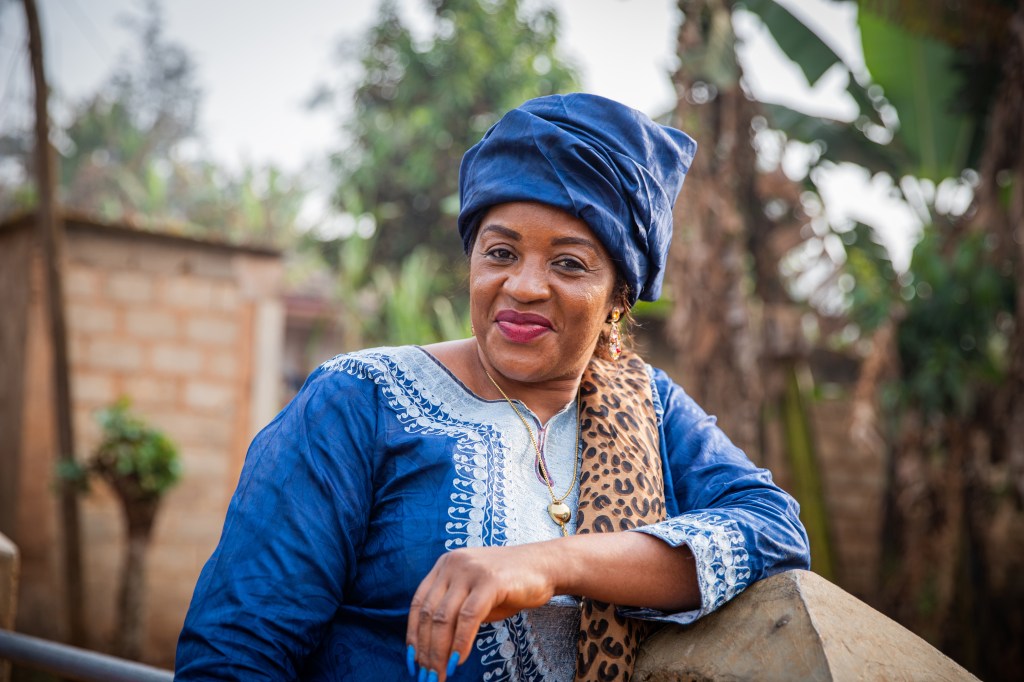
Portrait of an attractive and smiling 50 year old African woman dressed in a traditional African dress

However, what role did religion play in the abandonment of African culture and how did it aid in promoting racism and the inferiority of the black race? During the pre-colonial era, when missionaries arrived in Africa, their mission was to Christianize the black people with the presumption that their ways were primitive and their beliefs heathen. The missionaries believed in the biblical account of Ham, one of the three sons of Noah, who was allegedly black and cursed. This belief, coupled with the popular 19th-century pseudoscience that used dubious scientific methods to prove the superiority of the white race over the black race, led to the justification of slavery, colonization, and Christianization of Africa.

Christianity in itself is neither bad nor racist, nor is religion in general. But it was used as a tool to systematically lead Africans to abandon their cultures and traditions, most of which were good. The indoctrination of the continent has led to the vast majority abandoning the values of hard work and sacrifice for beliefs in prayer and miracles. As a result, there are numerous churches all over Africa where believers flock to and give their last dime to get a miracle.

Religion, in my opinion, did not set Africans free, but rather bound them to belief systems that left them vulnerable to exploitation. Africans quickly forgot that the promised paradise was what they were already living in. Instead of moving at the same pace as the rest of the world in terms of development, they were reduced to ethnic and religious wars as the colonizers looted the natural wealth of the continent.

Should Africa abandon religion? Absolutely not. And replace it with what? Remember that religion was there long before racism and colonialism existed. Belief is the basis of the morals of society. Once beliefs are eradicated, the society starts to decay. The only thinkable solution, in my estimation, would be for everyone to start accepting and appreciating African cultures. People, including Africans, should educate themselves on the deep-rooted beliefs that Blacks are inferior to other races.

Where would you start? Do you really know how ancient African societies lived? Are there practices and customs that would have been helpful for modern society? How can we help Africans use their rich natural resources to develop themselves? Speaking of natural resources, could they be the cause of Africa being the poorest and least developed continent in the world? We will cover the topic of natural resources in the next blog.
“Say Goodbye to the Art of Creative Writing: The Imminent Death of Blogging with the Launch of ChatGPT 4”

As the world eagerly awaits the launch of ChatGPT 4, a new and advanced language model developed by OpenAI, many in the blogging community are left wondering about the fate of creative writing. With the ability to generate human-like text with ease, it seems that the art of crafting thoughtful and engaging blog posts may be facing an imminent death.

The truth is, ChatGPT 4 is a game changer. With its advanced capabilities and sophisticated algorithms, it can generate text that is indistinguishable from that written by human writers. This means that bloggers, who have built their careers on the art of creative writing, will soon find themselves competing against a machine that can produce content faster, more efficiently, and with a level of accuracy that is unparalleled.

But it’s not just bloggers who will be impacted. Content creators of all types, from journalists to copywriters, will also find themselves facing increased competition from ChatGPT 4. The future of creative writing as we know it is uncertain, and the ramifications of this technology will be far-reaching.

For bloggers, the question becomes not just how to compete with a machine, but whether it’s even possible. With ChatGPT 4 able to generate text that is indistinguishable from that written by humans, it’s hard to see how bloggers can continue to create unique and engaging content that will attract readers.

Many bloggers have built their careers on the art of creative writing, but with the advent of ChatGPT 4, it seems that this art may soon become obsolete. While the technology has the potential to revolutionize the way we create and consume content, it also has the potential to put many bloggers out of work.

It’s not all doom and gloom, however. There are still ways for bloggers to survive in this new world. One way is to focus on niche topics and areas of expertise that ChatGPT 4 may not be able to replicate. For example, a blogger who specializes in a specific niche, such as travel or fashion, may be able to continue creating unique and engaging content that their readers will continue to enjoy.

Another way for bloggers to survive is to adapt their writing style and focus on creating more personal and emotive content. After all, while ChatGPT 4 may be able to generate text that is indistinguishable from that written by humans, it can’t replicate the human experience. Bloggers who focus on creating content that is personal and emotive, such as diary entries or personal essays, may be able to carve out a niche for themselves in the new world of content creation.

In conclusion, the launch of ChatGPT 4 is undoubtedly a game changer for the world of creative writing. It has the potential to revolutionize the way we create and consume content, but it also has the potential to put many bloggers and content creators out of work. But for those who are willing to adapt, there are still opportunities for survival in this new world. Niche topics and areas of expertise, as well as a focus on personal and emotive content, maybe the key to success in the new era of content creation.

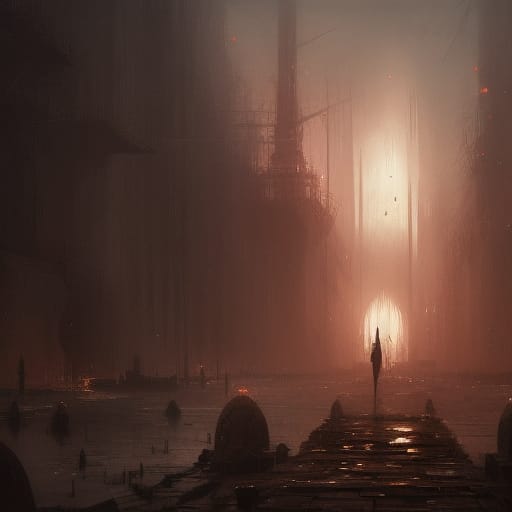
Text and Picture were generated by ChatGP3 and Nightcafe AI respectively.

YOUR MIND IS YOUR KEEPER, NOT YOUR FRIEND. THE FINALE

MAKING YOUR MIND YOUR FRIEND THROUGH NARRATIVE

Happy New Year, my dear readers. One of my new year resolutions is to increase my writings to one blog every week. I also am going to write not only non-fictional but also fiction. So first we finish the series ‘Your mind is your keeper, not your friend’.

My girlfriend once asked me, “What makes us humans different from other species?” After a moment of thought, I answered that humans can think in the abstract. We can create abstract concepts in our minds and bring them to reality. We improve our lives and make things easier by building tools and machines that help us realise our needs. For our psyche, we have Narratives.

We tell kids stories that terrify them from going out in the dark, talking to strangers and teach them lessons on the importance of good morals. Think of the boogeyman, the clever, witty hare, the goose that laid the golden egg, Jack and the beanstalk. These stories are powerful tools to teach us good values and protect kids from getting into trouble.

What separated humans from our cousins, the apes, are the narratives that we started telling ourselves. In every culture, country, and region, legends are passed on from generation to generation. Some tales are so intense that they are taken for actual historical events. People believe them so much they would take offence at any attempt to discredit them.

How did Narratives come to be? In the hunter-gatherer societies, the groups developed rituals like music and dancing to achieve social cohesion among the growing communities. As they settled in larger communities, narratives were adopted to manage pro-social behaviour and alleviate the stresses of living in large communities. This is how religion and nationalism came to be.

 Think of it for a moment; literary everything could be an illusion. Some thinkers suggest that we are characters being played in a simulation by aliens. Most countries with borders never existed until like 200 years ago. Still, the belief and pride in one’s country and their flag symbol is solid and evident from the wars and international competitions.

The power of belief in Narrative is also apparent in sport. Soccer, the most popular game globally, is religiously watched. A lot of resources are placed in a competition where 22 people chase around a ball in a field. This game is famed to transcend political, geographical and economic differences. It is one of the most beautiful, practical Narrative of rituals that unite people of all walks of life.

Most notably, though, is the Narrative that goes on in your mind. Look, no one chooses the Narrative they were born into. You did not choose the Narrative that males should behave in a particular way and females in another. You did not choose the Narrative of your IQ, education level, origins and physical attributes. That these, automatically determine whether the cards you draw in the game of life are good or unlucky ones. You did not choose to accept the Narrative that you have to be quiet and submissive to authority whether they are right or wrong. But many people suffer silently because they have been intimidated by narratives into self-censorship.

DON’T underestimate the power of narratives. Your mind sticks to a narrative even when it no longer suits your needs and desires. Remember the massacre in the 18th century by the Christian crusaders? It was a belief in the Narrative they were doing the Lord’s will. Remember the Gulags of Stalin and the famine that led to the millions who died. It was belief in the Narrative of Marxism. Have you heard of the dictatorship of Kim Jong Un in North Korea, that the people are not revolting out of their belief that their saviour is Kim? It is a narrative that has brewed fear and helplessness.

There are many narratives, some become obsolete with time, and some stand the test of time. For example, the teachings of Jesus in the sermon on the mount, life would be perfect if people followed that Narrative.

You need to keep evaluating your Narrative and updating it to have peace of mind and peace FROM mind. Look, after Hitler was defeated in the second world war, the Germans had to change the Narrative of how they viewed people from other races. Now Germany is one of the most diverse countries to live in.

Do your religious beliefs, cultural values, and personal truths make you happy? Does your ideology lead you to be tolerant and respectful to people with different narratives? Does your story challenge you to become the best version of yourself?

When reading about the concentration camps in Nazi Germany and Stalin’s USSR, it is human nature to identify and empathise with the victims. Aleksandr Solzhenitsyn, who wrote ‘The Gulag Archipelago’, suggested that we should also put ourselves in the shoes of the oppressor. That guard at the concentration camp, what Narrative was he telling himself as he watched people die a miserable death? The woman who snitched on her Jewish neighbour and his family and had them taken to the camps. What Narrative was going on in her mind?

Africa, where I was born and raised, what sort of Narrative are they holding on to so that they have to be dependent on foreign aid yet have mineral-rich and fertile lands as well as the youngest population of the world. How strong is that Narrative that most Africans in every election cycle for decades elect corrupt officials who care less about their own people but plunder their resources?

Think, my friend, maybe the story you have been holding on to is holding you back. Your beautiful mind can be your friend if it uses its unique neuroplasticity ability (adapting new narratives). Take up a better Narrative for yourself or upgrade the one you have. Make your mind your friend and your keeper.

Your Mind is your keeper, not your friend Part 3

Making your Mind your friend through Gratitude.

Gratitude is a very portent practice in bringing joy and well-being into life. The personal development sector is awash with numerous articles on why and how to use Gratitude as a practice to bring happiness, positivity and success into your life.

There are many ways of practising Gratitude. The most common is thinking of stuff you are grateful for, writing them down every day, and reflecting on them. I have tried that for some time, and it has had little effect on me. Waking up every day and thinking of what I am grateful for has given me an excellent start to the day. But that lasted only a couple of hours. After a week of doing that, I found myself scratching my head to find new stuff that I can be grateful for so that I am not constantly repeating myself. Sooner or later, I quit the practice altogether because I was no longer getting the desired effect.

Then I heard a podcast by Andrew Hubermann https://youtu.be/KVjfFN89qvQ. He explained where most people, including myself, get it wrong with the Gratitude practice. In this blog entry, I will not water down Dr Hubermann’s work by attempting to summarise it. So I urge you, dear reader, after reading my blog, go listen to it. It will definitely positively change the way you practice Gratitude.

My previous gratitude practice didn’t work because, at some point, the emotional connection was cut off between what I am grateful for and how I am feeling at that moment. Dr Hubermann explains: “you can’t fool your mind”, if the moment is crapy, it is crapy.

Now, the better gratitude practice entails remembering a moment where you genuinely received Gratitude from someone after you are done doing them a good did. Closing your eyes and visualising this moment has a tremendous impact on producing happy hormones. Studies have shown that the brain activity in Raphe Nucleus, which makes the happy hormone serotonin, is triggered by this practice of Gratitude.

It goes dipper when you hear of a story of how someone helped out another and was genuinely appreciated; as a result, the same part of the brain is also activated. That is why bible stories of Jesus are so powerful. Because they show how a compassionate man helped out needy fellows.

I decided to try out the practice as suggested by Dr Hubermann. So, my day job is driving the Tram. As I cruised one day, I tried to remember how I helped someone and they were genuinely grateful. I remembered how I approached a station some time ago and saw a phone lying on the ground. I stopped the Tram, came out and picked the phone from the ground. Then, after a while, the phone rang, and I answered to a distressed woman’s call who was thanking me so much for finding her daughter’s phone. I handed it back to her at my break and kindly declined a 10 euro reward from her. She was so grateful and wished me God’s blessings.

I smiled to myself, enjoying the sudden surge of serotonin in my system. But what happened next, I was not prepared for. At that very station, someone interrupted my bliss trip with a knock in my cabinet. He said he found a phone lying on the chair; someone must have dropped it and asked if I would be so kind as to give the owner if they called. How weird was that? I gladly accepted and thanked the man for his honesty and wished him a pleasant day.

The owner of the phone called and said he could not pick up the phone as he is a nurse at a hospital. I offered to bring it to him during my long break. He was delighted and tried to give me a 20 euro reward, which I again declined. I went back to work feeling so happy.

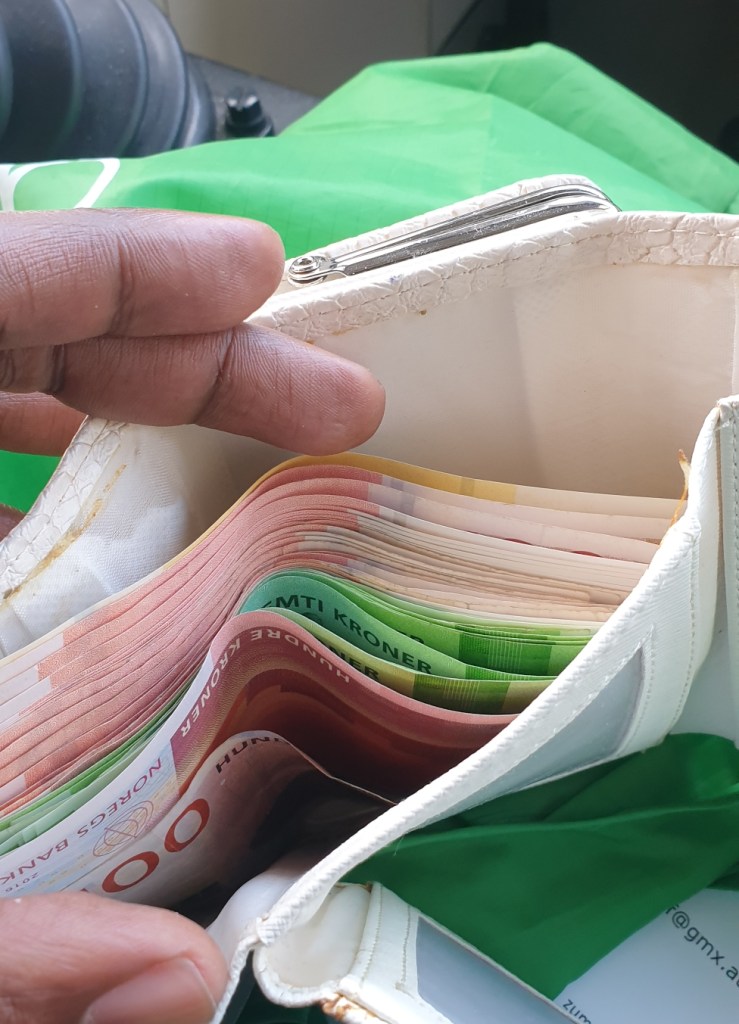
If you think that is the end of it all, you are not yet ready for this. Later that day, as I was doing the final round with the Tram, I went around checking for any lost and found items. I indeed found a green shopping bag. I took it with me to my driver’s cabin. I inspected to see if there were any valuables or contacts for the owner. I saw a purse and printouts with a name and address. In the purse were bills of an estimated 10,000 euros. As I debated in my mind whether to take the shopping bag to the police or deliver it personally to the owner, again, someone knocked at my driver’s cabin. It was a distressed old man. He asked if I had found a green shopping bag. I asked him for a name to confirm that it belonged to him. He gave his daughter’s correct names on the documents and explained that he was supposed to take the items to her, and he had feared he had completely lost them.

Having those experiences on the same days is entirely mind-blowing. Whenever I think of those experiences, I feel so happy about my honesty and how I saved that old man from the stress of explaining how he lost his daughter’s belongings. How did you feel when you read the joy the nurse had upon receiving his phone and the relief the old man had when he got his green bag back? A narrative is a powerful tool in triggering the right parts of our brain in response to a gratitude practice.

Next time tell a story about something good you did to someone and experience the surge of happiness as you recall the incident.