The Deceptive Handshake—When the mountain stops being a backdrop and starts being an opponent.
On Friday, December 19th, we traded the chaotic energy of Nairobi for the crisp air of Nanyuki a three hour drive from the city. We arrived at around noon, and over lunch, we met our guide, Wamururu, a tall man in his 60s, possessed of a soft, polite voice that stood in quiet contrast to the rugged landscape he commanded. Wamururu is a living legend in the mountain, known to conquer the climb at least 4 times every month. After briefing us on the itinerary ahead, he audited our ragtag collection of gear and pointed out the essential gaps we needed to fill at the local climbing gear-for-hire shops. By 4:00 PM, we stood at the Mt. Kenya National Park gate, where Wamururu introduced us to the ‘engine’ of our expedition, the real studs: David, his assistant guide, a cook, and seven porters who would be carrying our heavy gear all the way.
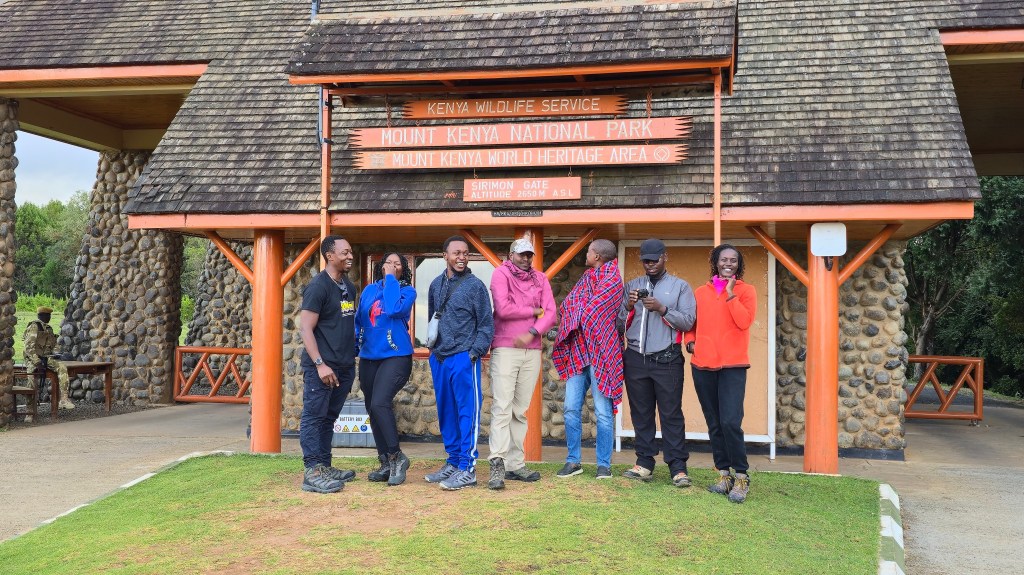
The first test was a choice: a 7km drive to the first camp, Old Moses, or a walk with a gradual ascent to acclimatize. True to our ‘unprepared but defiant’ spirit, we chose to walk. My 18-year-old brother, Davy, decided to push the envelope by carrying a 10kg porter bag; not to be outdone by my junior, I shouldered another to the surprise and laughter of the porters, who now had nothing to carry. It was a classic display of the ego—two brothers trying to prove their strength to a mountain that hadn’t even begun to breathe on them yet. The hike to Old Moses Camp was a deceptive paradise. We marvelled at Baboons and the prehistoric grace of the Common Eland, all while keeping a wary eye out for the buffaloes reported on the trail. While Davy and I maintained a steady, motivated pace, the sting of the incline began to settle into our friends’ legs. We reached Old Moses at 5:30 PM, flushed with the triumph of Day One—unaware that the mountain was simply letting us settle in before the real struggle began.
If Day One was a deceptive handshake, the first night at Old Moses was a cold interrogation. As the sun dipped, the temperature didn’t just fall; it plummeted, slicing through the thin nylon of our tents. I quickly realized that my flea-market gear and enthusiasm were no match for the predatory chill of high-altitude night. Sleep was an elusive luxury on the hard ground. Every few hours, the body demanded a trip to the pit latrines—a humbling, pitch-black pilgrimage through the frost to a hole in the ground that smelled of ancient decay and cold reality. There is no ego in a pit latrine at 3,300 meters; there is only the raw, shivering fact of your own biology.
I woke up on Day Two with a neck as stiff as the frozen grass outside and joints that screamed in protest. The ‘bravado’ of carrying my own 10kg bag the day before felt like a distant, foolish memory. At that particular moment, I questioned my life choices. Yet, looking toward the horizon, the motivation remained. We had 17 kilometres of gruelling terrain standing between us and our next stop, Shipton’s Camp. The ‘self-induced suffering’ I had sought in Austria was finally here, and it was demanding to be acknowledged. We packed our bags with trembling hands, knowing that the honeymoon was over—the mountain was about to stop being a backdrop and start being an opponent.
Day Two was a 17-kilometre lesson in humility. The morning started with a deceptive lightness; per the guide’s orders, we carried only our rucksacks with water and sandwiches, leaving the heavy lifting to the porters. For the first few kilometres, our spirits were as high as the Mooreland sun. We laughed, debated, and admired the surreal landscape of Giant Groundsels and Lobelias—plants that looked like they belonged on another planet.
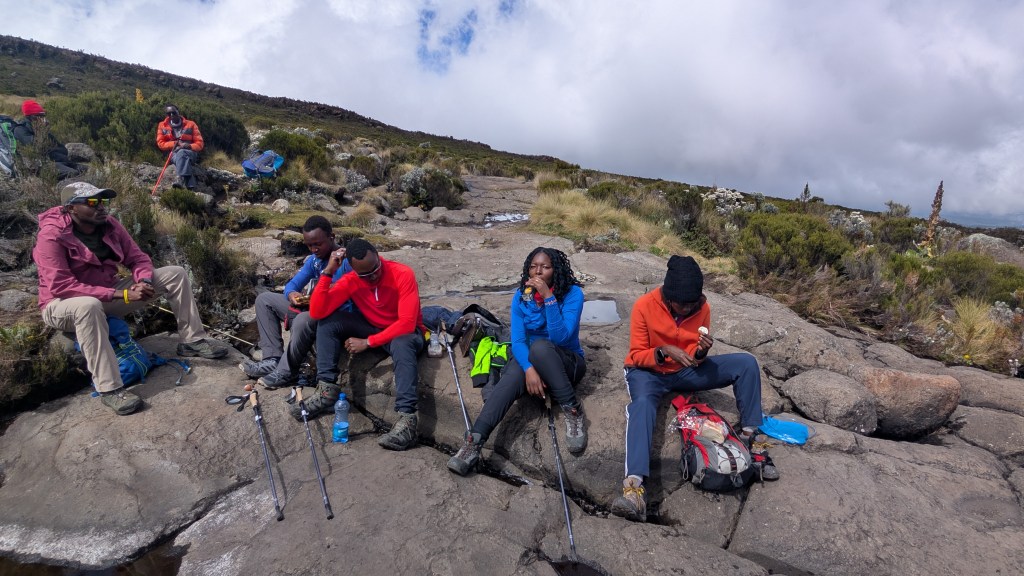
But as the oxygen thinned, the conversation died. Our Bluetooth speaker took over for a while, providing a rhythmic heartbeat to our steps, but eventually, even the music became an intrusion. By the eighth kilometre, there was only the sound of heavy breathing and the rhythmic, soft-spoken command of our guide, Wamururu: ‘Stop. Water break.’
Every ascent began to feel like a death sentence. We would crest a ridge, hoping for a reprieve, only to see another climb stretching toward the horizon. The sight of Point Lenana in the distance, once a beacon of excitement, now felt like a taunt. As altitude sickness and fatigue set in, our ‘team of dreamers’ grew irritable and frayed. Midway through, we sat gasping for air while our porters—carrying our heavy gear on their backs—overtook us with a steady, rhythmic grace, vanishing into the clouds as if the incline didn’t exist. It was a staggering realization of my own fragility.
The final ascent before Shipton’s Camp was the executioner—aptly named Wamururu Hill after our legendary guide. It loomed over us, steep, rocky, and winding toward the heavens as if mocking our fatigue. After 17 kilometres of gruelling terrain, we were completely depleted; our morale had vanished into thin air. It was in this moment of total collapse that I figured: hiring a professional guide was the most valuable investment of this journey.
At the base of this vertical wall, Wamururu, sensing our near-defeat, ordered us to stop. “Rest. Drink water,” he commanded with that soft, authoritative voice. He knew this hill was a spirit-killer. As we sat there gasping, he began to tell us stories—tales of his years on these peaks, of those who made it and those the mountain turned back. He didn’t just give us a break; he gave us perspective. He turned our focus away from our burning lungs and toward the legacy of the climb. When he finally gave the command to get up for the final push, we didn’t rise with physical strength—there was none left—but with a shared, borrowed resolve.
We finally crawled into Shipton’s at 6:00 PM. I collapsed onto the freezing earth and fell into a dead sleep of pure exhaustion, feeling like a weakling compared to the “stud” porters who had already set up camp and were moving with effortless grace, preparing our dinner. I was awakened briefly for dinner, my head throbbing with a mountain-sickness migraine, only to receive the most terrifying news of the trip: we would be woken up at 2:30 AM for the final summit. As I looked up at the dark, looming peak, I couldn’t believe I was expected to start again in just a few hours. I was broken. I looked at my team of dreamers, and the excitement and motivation to summit Kirinyaga in a few hours were gone. I knew we weren’t just climbing for ourselves anymore. We were climbing for the kids at Sifuyo who face their own “Wamururu Hills” every day just to get to a classroom.
The Lesson: Leadership isn’t just about showing the way; it’s about holding the space for others to find their strength when they think they are empty.
Our call for donations is in itself a Wamururu Hill. Help us reach the summit and turn this struggle into a foundation for Sifuyo Primary School: Support the Project
Watch the full video of our hike here
Next in Part 3: The Dark Night of the Soul—The 2:30 AM battle to find the energy that didn’t exist.
 jackmugoya